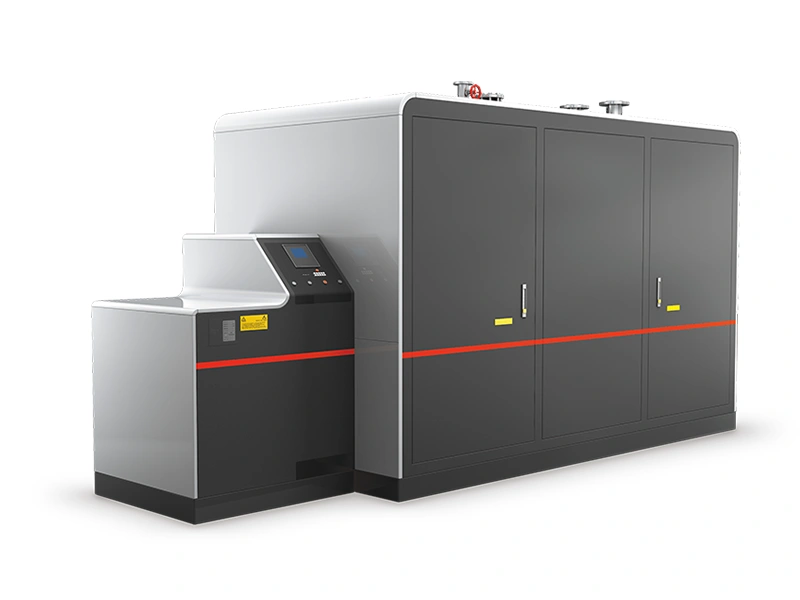
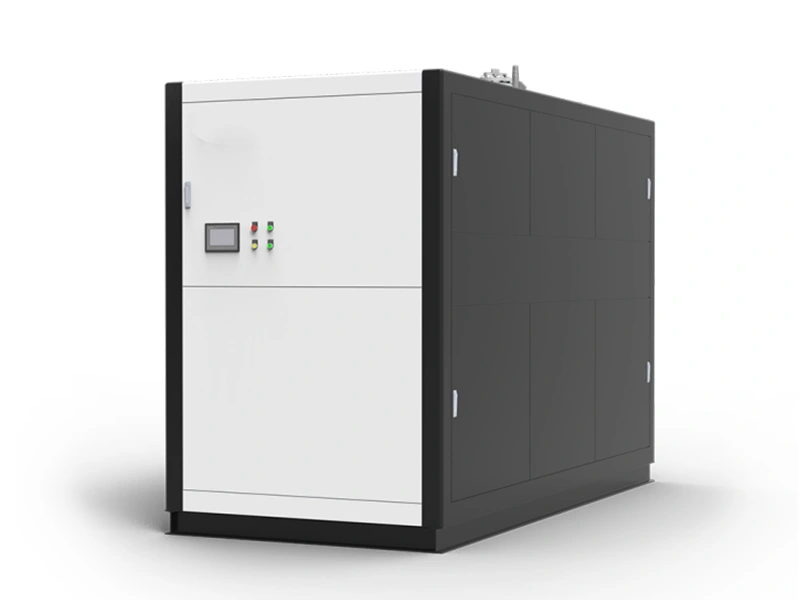
The vacuum hot water unit has the characteristics of safety and reliability, pressure bearing use, energy conservation and environmental protection, durability, multi-purpose, and simple operation.
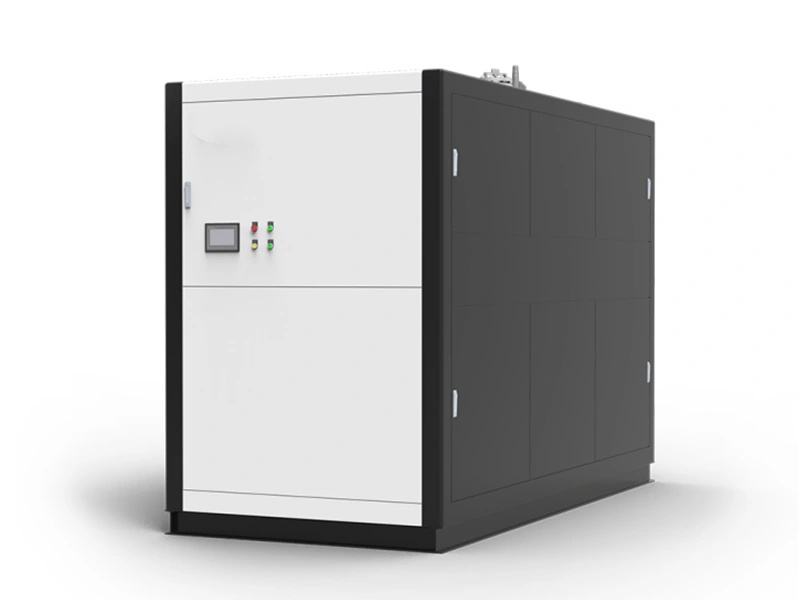
Introduction to the structure and performance of vacuum boilers
TFZ series vacuum hot water boiler is a new product that is safe, reliable, efficient, energy-saving, green and environmentally friendly. It can be widely used in hospitals, business office buildings, residential buildings, hotels, various bathing and leisure centers and other places that require heating and sanitary hot water. It can also provide circulating hot water for high-end swimming pools and other places that require heating and sanitary hot water.
Structural features
The front and rear double wet back three-pass smooth combustion structure, and the two-pass threaded smoke pipe technology improve the heat exchange performance.
The corrugated furnace technology is used to absorb the thermal expansion of the high-temperature furnace.
The front and rear ends of the furnace adopt a double wet-back structure. The high-temperature furnace is completely surrounded by water, which improves the stability of the furnace and reduces heat loss.
There is a flame observation hole in the front smoke box to observe the flame condition and facilitate combustion adjustment. .
The rear smoke box is equipped with a condensation water discharge port, so that the flue gas condensation water can be discharged in time to reduce corrosion.
Detachable front and rear smoke box doors, front and rear water chambers of the heat exchanger, and openable door shaft-type outer frames make operation and maintenance easier.
Safe and reliable
TFZ vacuum boiler always operates under negative pressure. The internal working pressure is always lower than the external atmospheric pressure. It is equipped with multiple safety protection measures such as over-temperature protection, over-pressure protection, and low water level protection. There is no danger of expansion, empty burning, or explosion. , with safety and reliability unmatched by normal pressure and pressure boilers.
Efficient operation
The boiler adopts a front and rear double wet back three-pass smooth combustion structure and uses a threaded smoke pipe to increase the heat exchange time of the flue gas inside the boiler. Each vacuum furnace is insulated before leaving the factory, which reduces the exhaust gas temperature and exhaust heat. loss, greatly improving boiler efficiency and reducing user operating costs.
Environmentally friendly combustion
The vacuum boiler adopts an original imported low-NOX burner, which has sufficient combustion and smoke emission below the legal standard, fully complying with the requirements of the first-class national area. In addition, the boiler room can be located in various places such as basement, ground, middle of floor, and roof, which greatly saves construction land.
long lasting
Use high-purity, specially degassed heat medium water to eliminate oxygen corrosion and create a vacuum without oxygen. The inside of the boiler will never scale, greatly reducing corrosion of the steel plates inside the machine, and the service life is semi-permanent. The components of the internal heat exchanger are connected by bolts to facilitate the inspection, maintenance and upkeep of the equipment.
cleaner
The heat exchanger uses high-quality seamless copper tubes or stainless steel for heat exchange and is placed directly inside the drum, making the hot water generated cleaner and more hygienic and can be used directly by users. The short preheating time of the boiler only takes 3 to 5 minutes, which greatly reduces the user’s operating costs and extends the service life of the boiler.
high degree of automation
Using microcomputer automatic control, it can automatically adjust fuel consumption according to changes in load through computer calculation, greatly saving users’ operating costs. It also has a fault diagnosis and prediction function, which can detect the possibility of faults in advance, allowing users to prevent problems before they happen. It also greatly reduces the labor intensity of operators, and automatic operation can be realized with just one click.
More convenient to use
This unit ensures that users can operate under automatic control at 90°C. At the same time, the operating parameters can be modified within the temperature range of 25°C to 90°C to implement automatic operation according to user requirements. The boiler and heat exchanger are integrated, and at the same time, there is no need for a hot water circulation pump, which saves considerable electricity and other costs for operation.
1. Over-temperature protection – the furnace will shut down and alarm when the set temperature is exceeded.
2. Overpressure protection – the furnace will shut down and alarm when the set vacuum pressure is exceeded.
3. Mechanical overpressure bursting protection – the bursting disc operates when the pressure exceeds 0.07Mpa.
4. Gas leakage protection – if a trace amount of gas leakage from the solenoid valve is detected, the furnace will shut down and alarm.
5. Gas pressure too high or too low protection – the gas pressure is too high or too low and the furnace shuts down and alarms.
6. Combustion abnormality protection – furnace shutdown alarm for combustion failure, flameout, etc.
7. Anti-freeze protection – automatically starts the furnace when the temperature is lower than the set temperature to prevent equipment from freezing.
1. Boiler noise generation
Boiler noise is mainly caused by the operation of the burner. The boiler used in this bidding is an Italian Riello burner. According to the test data provided by the burner company, the noise value is ≤79dBA.
2. Noise control value
According to the requirements of GB50041 “Code for Design of Boiler Rooms”, the overall noise value of the boiler room should be ≤85.
This project recommends users to use a silencer device, which can greatly reduce the noise hazard in the boiler room. The silencer is optional for the user, and the price of each silencer is 10,000 yuan.
The noise value of the boiler after adding a silencer cover is ≤68 Dba
1) Measures to reduce vibration of the unit
①The unit has almost no vibration and generally does not require shock absorption. If the unit is placed on the middle floor, anti-vibration rubber pads can be placed under the frame.
② It is recommended to use anti-vibration hose joints to isolate the pipeline from the flange of the unit to avoid the transmission of vibration, noise and mutual interference.
2) Measures to reduce the noise of the unit. The noise of the hot water unit mainly comes from the burner. Installing a silencer on the blower device of the burner significantly reduces the noise when the burner is working:
3) Features of the unit:
① Compact design, in line with aerodynamics and low operating noise level;
② Brand new air inlet and damper control system. The special shell design, innovative air supply method and advanced blowing technology increase the blowing pressure, thereby achieving greater power in a small volume;
③The damper control system can also maintain a high degree of linearity in the low-end operating range, which is consistent with The standard air inlet silencer ensures quieter operation. The standard air inlet silencer further reduces operating noise;
④ Quieter and unique air inlet design and use of sound insulation materials ensure ideal noise emission. For special environments that require lower noise, a silencer cover can be configured to reduce the noise by 15-20dB(A).
Performance and characteristics of boiler body insulation materials
The cylinder body is made of ultra-fine glass wool; the smoke box is made of aluminum silicate felt; the front and rear smoke box covers are sealed and welded with heat-resistant steel plates to ensure that the insulation layer is not damaged.
The boiler shell is insulated using a structure of high thermal resistance aluminum silicate fiber + heat reflective film + thermal insulation cotton. While considering reducing the convection heat loss of the boiler, the unique heat reflective film design effectively reduces the boiler radiation heat loss, so that the shell heat dissipation loss is reduced to The lowest (<0.5%).
Performance features:
1. Ultra-fine glass wool: small bulk density, low thermal conductivity, good sound absorption performance, non-combustible and corrosion-resistant, and has excellent thermal insulation, heat insulation and sound absorption functions.
2. Aluminum silicate felt: high temperature resistance, the maximum operating temperature is 1260 degrees.
3. Low thermal conductivity and good thermal insulation performance can greatly reduce boiler heat loss.
4. Light weight, the bulk density is 1/5~1/10 of ordinary refractory materials and 1/20 of ordinary refractory bricks, so the volume and weight of the boiler are reduced.
5. The heat capacity is small, 3 to 5 times that of other materials, so it heats up slowly and consumes less heat. It is a new type of energy-saving thermal insulation material.
Hamada Heating has always been committed to providing energy-saving and environmentally friendly boiler products.
The main measures taken by Hamada Thermal to save energy include:
1. It adopts a front and rear double wet flue gas three-pass structure, and the high-temperature furnace is completely surrounded by water to reduce heat loss q5.
2. The flue gas flow is lengthened, and the flue gas flows through two return smoke pipes to make the heat exchange of the flue gas more complete.
3. The technology of installing stainless steel flow surrounds in the smoke pipe is used to increase the degree of flue gas turbulence and improve the flue gas convection heat transfer coefficient.
4. Sufficient flue gas heating surface and low exhaust smoke temperature design reduce exhaust heat loss q2.
5. Optional advanced imported PID proportional burner, better fuel-air mixing, more complete combustion, reduced gas incomplete combustion heat loss q3, solid incomplete combustion heat loss q4 to zero. At the same time, it can burn with a lower excess air coefficient and reduce exhaust heat loss q2.
6. The surface of the furnace body is insulated with high thermal resistance aluminum silicate fiber. There is a beautiful boiler shell on the outside of the insulation layer. The average temperature of the shell surface is less than 35 degrees, which reduces heat dissipation loss q5.
7. Using a fully automatic intelligent vacuuming device, the condensed water returns to the boiler without losing the heat medium water.
8. The boiler can be equipped with a built-in fin tube type tail economizer, which uses low-temperature return water to recover the waste heat of the flue gas, reducing the exhaust gas temperature to 80°C, which can increase the thermal efficiency of the boiler to more than 98%.
Tested by the Zhejiang Provincial Special Equipment Inspection Center, the rated load thermal efficiency of the boiler is as high as 98.5%.
The vacuum leak detection process should be carried out after the furnace air tightness test and the heat exchanger water pressure test have passed.
Valve and instrument assembly.
Remove any moisture that may remain in the furnace body;
The vacuum pipeline is connected to the vacuum pump;
Weld an evacuation valve to the pipe connecting the vacuum pump;
Clean the dust on the outer surface of the inner tank tube assembly;
Connect the vacuum pump and the helium mass spectrometer leak detector;
Start the vacuum pump to evacuate the inner tank;
Start the helium mass spectrometer leak detector;
Adjust the helium mass spectrometer leak detector to the standby state;
First close the evacuation valve and check the tightness of the evacuation pipeline.
The instrument should have no leakage indication;
After confirming that there is no leakage in the evacuation pipeline, reopen the evacuation valve and continue to evacuate the boiler until the vacuum degree in the mass spectrometer chamber meets the leak detection requirements;
Before starting formal leak detection, prepare helium gas and spray gun.
After confirming the instrument background noise of the helium mass spectrometer leak detector, adjust the helium peak;
Start the filament, slowly open the throttle valve, and slowly and gradually close the front valve of the vacuum pump;
After adjusting the openings of the throttle valve and the front valve of the vacuum pump, record the background noise of the system;
Apply helium, carefully observe the changes in the instrument, and turn on the buzzer to monitor;
The sequence of helium spraying should start from the highest weld and gradually spray helium downward;
Check each weld one by one, and mark the unqualified parts where the leakage rate exceeds the specified value (1×10-12Pa·m3/s)
After all inspections are completed, vent the pressure in the furnace;
Repair the welds of unqualified parts;
After repair, perform the vacuum leak detection process again until it is qualified;
Data recording, data recording content includes:
Date and time, person testing
Instrument status (background, helium peak, system background, etc.)
Leakage rate of each weld
Repair capital
Tefu boiler uses UL1000 helium mass spectrometer leak detector produced by German INFICON company for vacuum leak detection.
The ultimate vacuum of UL1000 is as high as 5×10-12nbar·L/s, which is 5×10-13Pa·m3/s.
Technical parameters of UL1000 helium leak detector:
Maximum inlet pressure 15 mbar
Lowest detectable helium leak rate
• Vacuum mode 5×10-12 mbar l/s
• Inhaler mode 1×10⁻⁷ mbar l/s
Maximum displayable helium leak rate 0.1 mbar l/s
Measuring range: 12 levels
Time constant of leak rate signal <1 second
Pumping speed at air inlet (helium)
Rough pumping capacity 25m3/hour (50Hz)
30m3/hour (60Hz)
• Vacuum mode
– GROSS mode 1.25 liters/second
– FINE mode 1.5 liters/second
– ULTRA mode 2.5 l/s
Checkable quality numbers 2, 3 and 4
Mass spectrometer 180°
sector magnetic field
Ion source Two cathodes;
Iridium/Yttrium Oxide
Air inlet DN25KF
Start-up time (from power on) ≤3 minutes
Power supply, single phase (depending on model)
Part Number 550-000 230V10%,50Hz
200V 5%,50Hz
Part No. 550-001 115V 10%, 60 Hz
100V 10%,50/60 Hz
Part No. 550-002 100V10%,50/60 Hz
Power loss 1100 VA
Protection type IP40
Power cable (EU, USA, UK) 3 meters
Valve solenoid valve
Dimensions (width×height×depth) including handle (mm) 1068×525×850
Dimensions (width × height × depth) including handle (inches) 42×21×33
Weight (kg) 110
Weight (lbs) 242
Noise level dB(A) <58
Audio warning dB (A) 90

Energy Engineering EPC Professional Service Provider




 中文
中文